Are Early Staffing Decisions Preventing Schools from Rethinking Section Counts?

Are Schools Offering the Right Number of Sections?
Imagine a school that offered four sections of Biology. As it plans for the upcoming academic year, it decides to offer four again, based on previous enrollment and expected demand. But what if student course requests show that only three sections are needed? This is a challenge schools face when building their master schedules. Section counts are often estimated before student requests are finalized, in order to plan staffing in advance. However, when actual student demand differs from these estimates, schools may find it difficult to adjust section counts because teaching assignments have already been made.
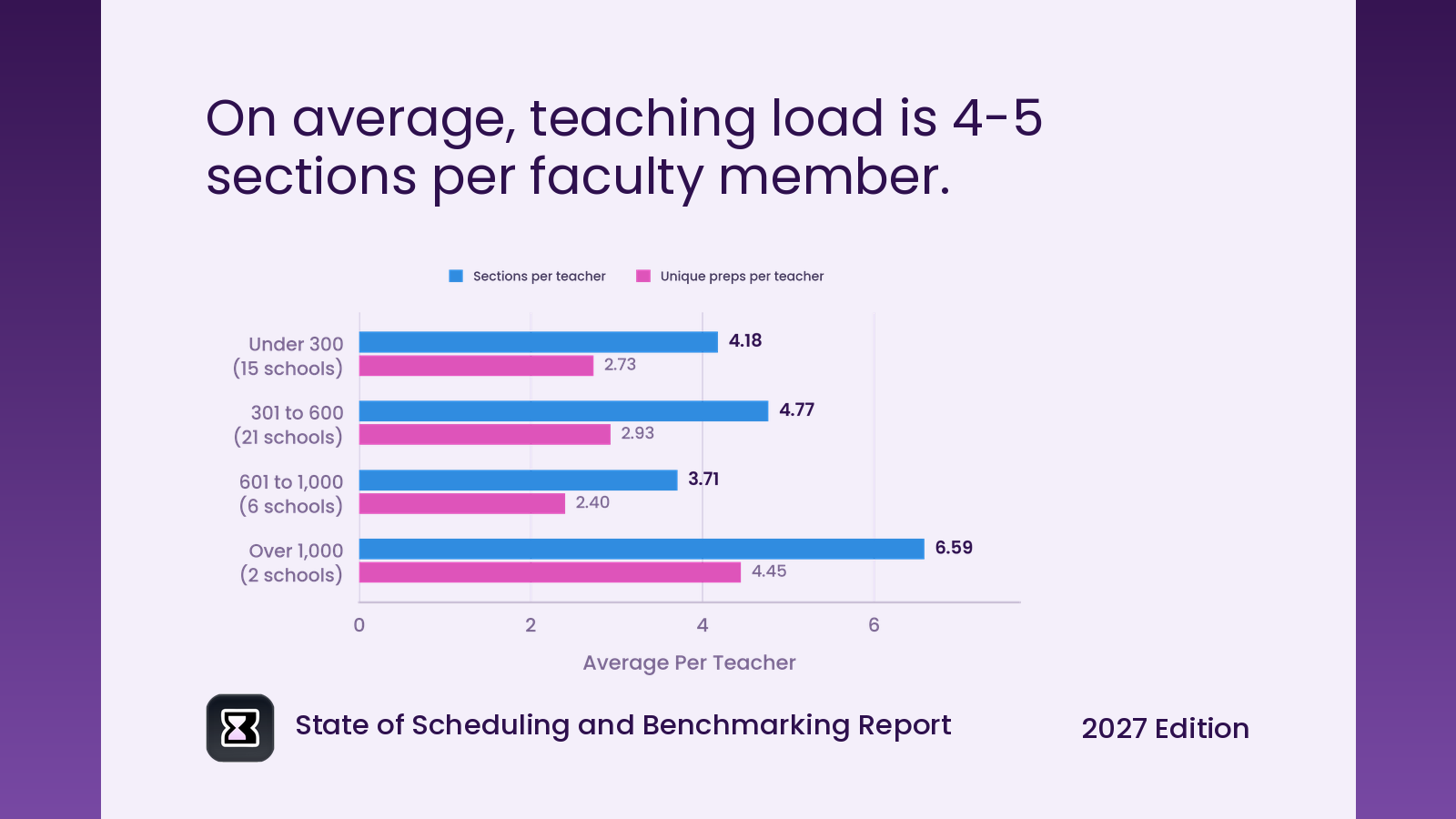
Decisions like these directly influence teaching loads, since every section a school offers must be assigned to a teacher. As part of ScheduleX's State of Scheduling & Benchmarking Report, we analyzed teaching loads across 44 private schools. We found that the typical school averaged 4.5 sections per teacher, with 29 of the 44 schools averaging between three and five sections.
These figures help schools understand how teaching loads compare, but they don't necessarily indicate whether the right number of sections is being offered. A school could have reasonable teaching loads while offering more sections than student demand requires in some courses and too few in others. So, evaluating teaching capacity shouldn't stop at how many sections teachers are assigned. Schools also need to consider whether those sections are aligned with actual student demand.
This raises an important question: How many schools continue to offer sections based on historical assumptions without testing whether those numbers still reflect what students actually need?
From the Field
A school in Georgia initially planned to offer 422 sections for the academic year. But when its sectioning plan was evaluated against actual course requests, it found that a different schedule arrangement could meet demand with just 299 sections. That's 123 fewer sections, representing a potential 29% reduction in the teaching capacity required to meet student demand.
What's interesting here isn't simply that the school could potentially operate with fewer sections. It's that the original plan may have committed teaching capacity to courses that didn't require as many sections, while leaving less flexibility to accommodate demand elsewhere.
Of course, this doesn't mean every school can reduce its section count by 29%, or that every section identified in the comparison could be eliminated without affecting other priorities. Class sizes, course offerings, teacher qualifications, and scheduling conflicts all influence how many sections a school needs.
Questions School Leaders Should Be Asking
1. Are schools' sectioning and staffing decisions flexible enough to respond to student demand? Schools often plan sections and make staffing commitments before student requests are finalized. But when actual demand differs from initial estimates, can these decisions be adjusted? Schools should consider whether they can add or reduce sections and reallocate existing teaching capacity rather than treating their initial plans as fixed.
2. Have schools tested alternative sectioning configurations before finalizing the schedule? A workable sectioning plan isn't necessarily the most effective one. Testing different configurations can help schools understand how changes to section counts affect course fulfillment, class sizes, and teaching loads, and identify the arrangement that best supports their priorities.
What Does This Mean for Schools?
The Georgia school's 422-to-299 sections example highlights how differently a school's sectioning requirements can look when evaluated against actual student demand. But that doesn't mean every school should aim to reduce its section count. Some schools may deliberately offer smaller classes, preserve specialized courses, or maintain additional sections to provide greater scheduling flexibility. The important question is whether those decisions are intentional or simply carried forward from previous years. We explore more questions like this in ScheduleX's State of Scheduling & Benchmarking Report, using data from 48 private schools across 18 U.S. states and territories. Check out the report to learn more.


Your questions, our
answers
Everything you need to know about ScheduleX. Find answer to the most common question
Absolutely! ScheduleX allows you to add all your rules and requirements - as complex as they come - directly into the system. Our algoirthm will then generate schedule scenarios based on these rules.
You can upload your school’s data, configure your rules and constraints, and our AI-powered algorithm will generate multiple schedule options for you to choose from. Alternatively, you can visualise and build your own schedule from scratch.
Once you upload your data, the first schedule can be ready in as quickly as a couple of hours.
No, but your SIS will definitely thank us.
Until you’re happy with what you have. No cap :)
You can export your schedule in a .csv file that can be easily imported into popular SISs like Blackbaud, Veracross, Facts and others.