Does School Size Determine Class Size?

Do Larger Schools Really Have Larger Classes?
It's reasonable to assume that larger schools might have bigger classes. As enrollment grows, schools need to accommodate more students, and class sizes might increase as a result. But does a school's enrollment actually determine how large its classes are?
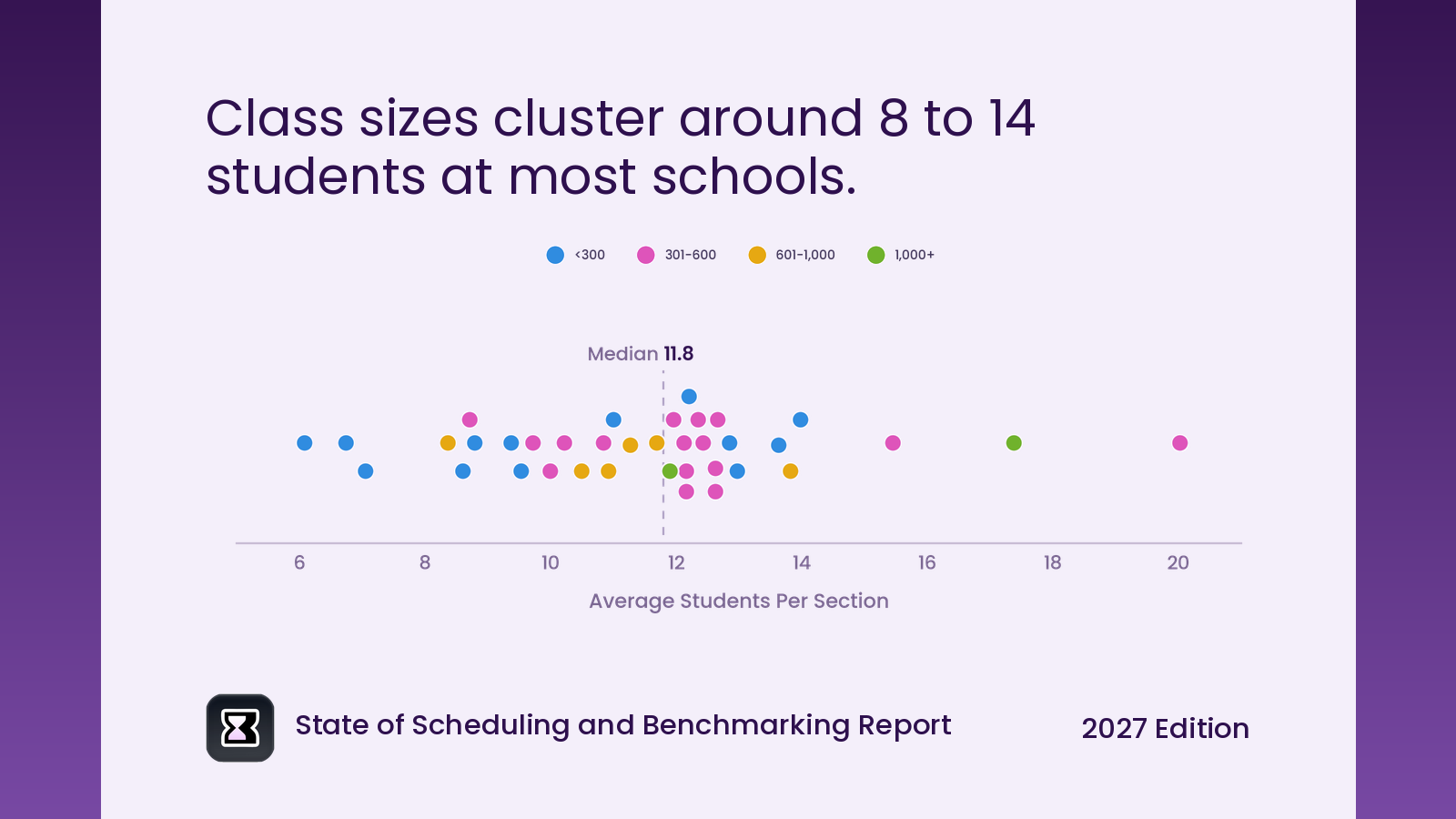
As part of ScheduleX's State of Scheduling & Benchmarking Report, we analyzed class sizes across 37 private schools with usable section-level data. We found that the typical class had an average of 11.8 students per section, with school-level averages ranging from 6 to 20 students. In fact, 31 of the 37 schools had average class sizes between 8 and 14 students.
What makes this interesting is that larger schools didn't necessarily have larger classes. Schools with 600 to 1,000 students averaged 11.1 students per section, comparable to, and sometimes lower than, schools below 600 students.
The findings suggest that enrollment alone doesn't explain class size. A school's decisions about how many sections to offer, how to distribute students, and what class sizes to target also play an important role. And that raises a question worth asking: Are your class sizes the result of deliberate decisions, or simply what your schedule ends up producing?
Why Should Schools Treat Class Size as a Scheduling Decision?
Fulfillment and section balance are numbers you read off the schedule after you build it. You find out where they landed. Class size works the other way. You set it going in, before scheduling starts and before students have even registered. That makes it a decision, not a result, and a decision deserves more scrutiny than a number you inherit.
So the useful question is how you set the class size. Typically, the limiting factors are room size and maintaining a student-teacher ratio. But there is more opportunity here than schools realize.
The common pattern is to reduce class size to a single figure and apply it everywhere. Target eighteen students in a class or cap every section at twenty. Although that number is easy to state and easy to defend in a budget meeting, as a scheduling constraint it is rigid. Instead a better way to do this is to have dynamic class sizes and define a range instead of a set value. For example, give each course a minimum, a target, and a maximum. A section might aim for fourteen, run with as few as ten, and stretch to eighteen when it has to. The target still guides the schedule build, but the range around it gives the schedule space to move.
Questions School Leaders Should Be Asking
1. Are we looking at the distribution of class sizes or just the average?
An overall average doesn't reveal how many sections are significantly larger or smaller than intended. Look at the full distribution to identify where class sizes differ from your targets and whether those differences need attention.
2. Are our class sizes a deliberate choice or a result of how we've traditionally built our schedule?
Schools often carry forward the same section sizes and enrollment limits year after year. Have you revisited these decisions as student demand, course offerings, and staffing have changed? Consider whether different section configurations could produce better outcomes.
3. Where would smaller class sizes make the greatest difference?
Not every course needs the same number of students. Some subjects, teaching formats, or student groups may benefit more from smaller sections than others. Are your class size targets aligned with these academic priorities, or do you apply similar limits across the board?
What Does This Mean for Your School?
The findings suggest that schools of different sizes can maintain relatively small classes. But that doesn't mean every school should aim for the sample median of 11.8 students per section.
Smaller classes can support important academic goals, but they also come with trade-offs. Reducing class sizes may require additional sections, increase teacher workloads, or create more scheduling conflicts. The important thing is to understand how class size decisions affect these other priorities and whether the resulting schedule reflects what the school wants to achieve.
A caveat on the numbers: All schools in this analysis use ScheduleX, so the findings may not represent private schools as a whole. Our data also includes PE, health, study hall, and certain non-academic periods, which may have different enrollment patterns from traditional academic courses. Their inclusion can affect the reported numbers.
Class size is only one part of the scheduling picture. Schools also need to consider how their decisions affect course fulfillment, section balance, teacher loads, and room utilization.
We explore these metrics in ScheduleX's State of Scheduling & Benchmarking Report, using data from 48 private schools across 18 U.S. states and territories. Check out the findings and see how your school's scheduling outcomes compare.


Your questions, our
answers
Everything you need to know about ScheduleX. Find answer to the most common question
Absolutely! ScheduleX allows you to add all your rules and requirements - as complex as they come - directly into the system. Our algoirthm will then generate schedule scenarios based on these rules.
You can upload your school’s data, configure your rules and constraints, and our AI-powered algorithm will generate multiple schedule options for you to choose from. Alternatively, you can visualise and build your own schedule from scratch.
Once you upload your data, the first schedule can be ready in as quickly as a couple of hours.
No, but your SIS will definitely thank us.
Until you’re happy with what you have. No cap :)
You can export your schedule in a .csv file that can be easily imported into popular SISs like Blackbaud, Veracross, Facts and others.