Does Your School Really Need More Classrooms To Make Your Schedule Work?

Are Schools Making the Most of Their Existing Classrooms?
When schools struggle to accommodate additional courses or sections, one of the first explanations is often a lack of space. Classrooms are full, teachers need dedicated rooms, and there simply doesn't seem to be enough room to expand the academic program. But what if the problem isn't the number of rooms a school has, but rather how effectively it's using them?
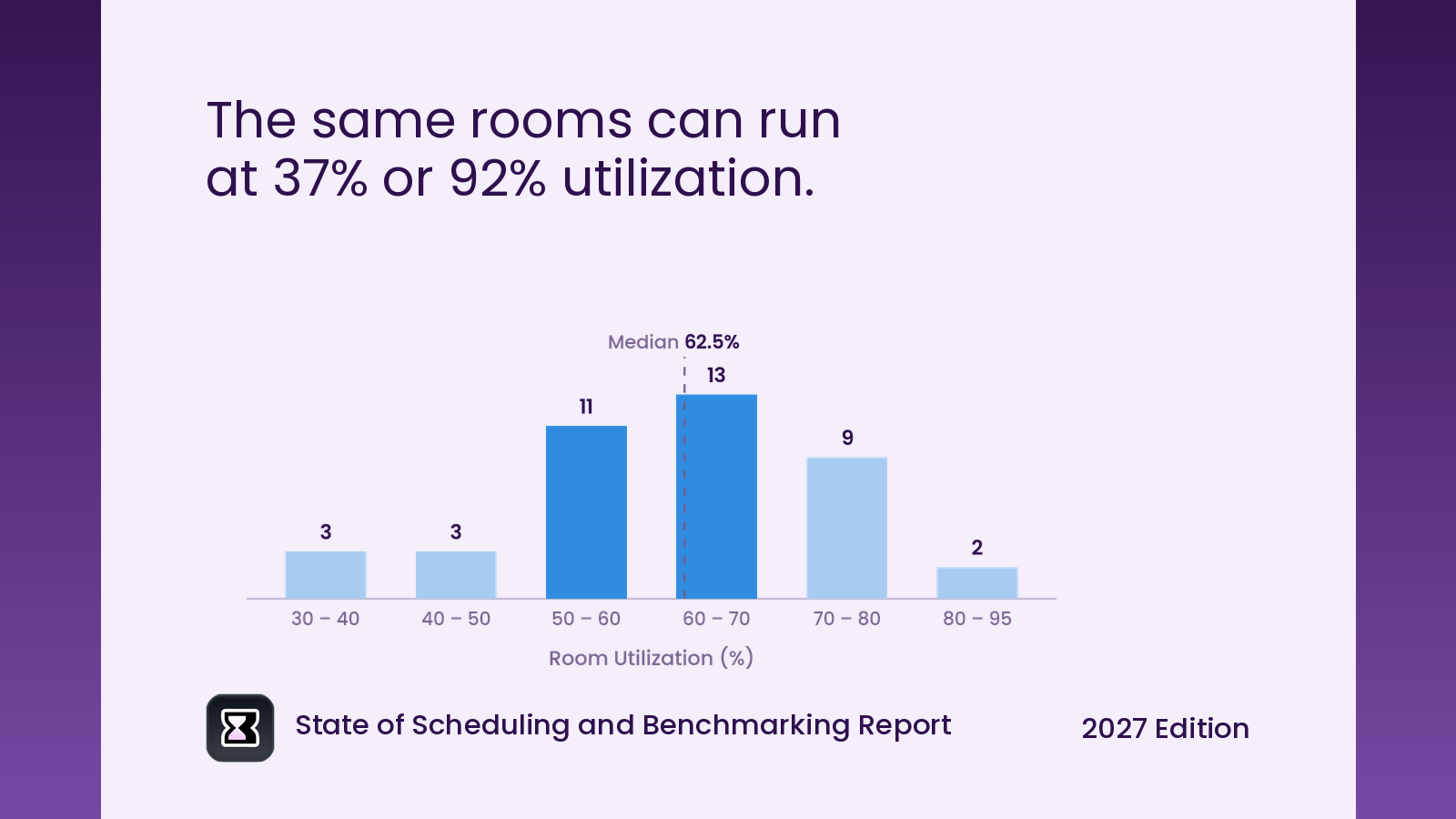
As part of ScheduleX's State of Scheduling & Benchmarking Report, we analyzed room utilization across 41 private schools. We found that the typical school utilized just 62.5% of its available classroom time. In fact, 30 of the 41 schools had utilization rates below 70%, with individual schools ranging from 37% to 92%. That means more than a third of available classroom time went unused at an average school in our analysis.
These findings raise an important question: Are schools running out of classroom space, or are their existing scheduling constraints preventing them from using the space they already have?
From the Field
Consider a school near Washington, DC, that had built its master schedule manually for decades. The school believed it had reached the limits of its classroom capacity and was considering a new building to accommodate additional courses and students. The estimated investment was between $5 million and $10 million. However, when the school examined its room utilization, it discovered that several classrooms were operating at roughly 50% capacity.
The issue wasn't necessarily a shortage of physical space. Existing room assignments and scheduling constraints were limiting how the school could use its classrooms. This finding prompted the school to reconsider whether expanding its facilities was the only way to accommodate its academic needs.
It's an important distinction, particularly when decisions about facilities involve investments of millions of dollars. Before concluding that a school needs more classrooms, it's worth understanding how much of its existing capacity it actually uses.
Why Do Schools Have Unused Classroom Capacity?
A school might have several empty classrooms throughout the day and still struggle to find a room for a particular course. This can happen because room availability depends on more than whether a classroom is physically empty. For example, a teacher might prefer to teach in the same room throughout the day. Certain classrooms might be reserved for specific departments, while others may have equipment that limits which courses can use them.
Some of these restrictions are necessary. Science labs, art studios, and other specialized spaces serve specific academic purposes. But other room assignments may reflect longstanding preferences or practices that schools haven't revisited. When schools treat these arrangements as fixed, they can limit the flexibility available to accommodate additional courses. That's why room utilization alone doesn't tell the whole story. Schools also need to understand which rooms are available for which courses, and whether their existing policies make the best use of that capacity.
Questions School Leaders Should Be Asking
1. Which of your room rules are real, and which are just habits?
Some teachers want a room of their own. Some departments hold certain spaces for their own courses. Each rule had a reason once, but few schools sort the ones they still need from the ones they’ve just kept. Write down each rule and why it exists. That list tells you which constraints are real and which you inherited.
2. Could your current rooms already hold more courses?
A new elective feels like it needs a new room. Often it just needs a different arrangement of the rooms you have. Test that before you decide the program has outgrown the building.
3. What would better room utilization actually get you?
Imagine your rooms ran at 85% instead of 62%, what could you add? For most schools this could mean more electives, or more sections of the courses students already want.
What Does This Mean for Your School?
The findings suggest that schools may have more unused classroom capacity than they realize. But that doesn't mean every school should aim for 90% utilization or that every empty classroom represents an opportunity to add another course. Some schools may deliberately maintain lower utilization to preserve dedicated teaching spaces, accommodate specialized courses, or provide flexibility during the school day. What matters is understanding whether these decisions reflect academic priorities or scheduling limitations that schools could reconsider.
A caveat on the numbers: All schools in this analysis use ScheduleX, so the findings may not represent private schools as a whole. We also excluded rooms that never appeared in the schedule from our utilization calculations. As a result, the figures may not capture all the unused space available at each school.
Room utilization is only one part of the scheduling picture. Schools also need to consider whether their classroom assignments affect course fulfillment, section offerings, teacher schedules, and other priorities.
We explore some of these metrics in ScheduleX's State of Scheduling & Benchmarking Report, using data from 48 private schools across 18 U.S. states and territories. Check out the findings and see how your school's scheduling outcomes compare.


Your questions, our
answers
Everything you need to know about ScheduleX. Find answer to the most common question
Absolutely! ScheduleX allows you to add all your rules and requirements - as complex as they come - directly into the system. Our algoirthm will then generate schedule scenarios based on these rules.
You can upload your school’s data, configure your rules and constraints, and our AI-powered algorithm will generate multiple schedule options for you to choose from. Alternatively, you can visualise and build your own schedule from scratch.
Once you upload your data, the first schedule can be ready in as quickly as a couple of hours.
No, but your SIS will definitely thank us.
Until you’re happy with what you have. No cap :)
You can export your schedule in a .csv file that can be easily imported into popular SISs like Blackbaud, Veracross, Facts and others.